The words spy, and Benjamin Franklin are not usually associated with each other, even with the rumors and assertions that Ben might have been a spy … for the British! That seems a bit far-fetched as he was basically kicked out of London because some higher ups in the British political food chain thought he was in England to spy on them!
Whether he was a spy for either side is debatable to this day. But, that didn’t mean he was spy-free. The colonists needed help both financially and militarily. If this thing happened. This revolution! If they really decided to try and outwit the British on the battlefield, it would be costly. The British military was the most highly trained and financially backed Army and Navy in the world at that time.
- What the colonists didn’t know was that all of the crazy taxes they were being forced to pay was because financially, Britain was in trouble with the bank! The French and Indian war of 1754-1763 had put a major dent in their bank account. Hypothetically, with more money, they could have sent more troops to the colonies. The American Revolution might have been the American … “well we gave it a try” Protest!
Fortunately, that didn’t happen. And the old guy who could take credit for that was a man by the name of— Benjamin Franklin. But he couldn’t do it in the open, at least, not yet!

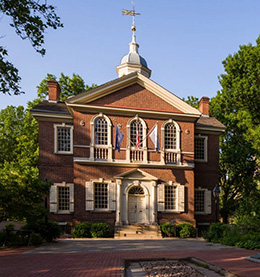
Living only a few blocks away, Benjamin Franklin had close ties to the building at 320 Chestnut Street known as Carpenters’ Hall.
The second floor was the location of the Library Company of Philadelphia, a Franklin invention. In 1773 he rented out the second floor in this recently constructed building for his library. I’m not sure whether he knew that the following year the first floor would become famous for hosting the first Continental Congress in 1774. That was before the group moved to the Pennsylvania State House in 1776. Its later name would be dubbed, Independence Hall putting Carpenters’ Hall in the shadows, less than two blocks away.
The second floor was also a safe place for Franklin to meet with Julien Achard de Bonvouloir in December of 1775 for several meetings. You probably won’t find Bonvouloir’s name in any American History textbook at your local high school. Bonvouloir was not only a French emissary, more covertly, a French spy!
It was lucky that Franklin hired a librarian who spoke both French and English. Frenchman, Francis Daymon. Or, was it luck?
Franklin was a member of the Committee of Secret Correspondence that was founded just prior to his series of secret meetings with Bonvouloir. Not great at French, Franklin just happened to have an employee who could translate for him!
It was Franklin’s job to convince Bonvouloir that the colonists were serious about independence. Sitting in with them was John Jay who probably didn’t say a whole lot, letting Franklin wax poetic about their cause.
In a real “Mission Impossible” move, the King of France told Bonvouloir if he was caught, they would disavow any knowledge of him. “And for the love of Pierre! Don’t get caught with any paperwork!” And for good measure, “just listen, don’t talk!”
“You’re not a diplomat! You’re a spy!”
And just so he understood his place in these secret meetings.
“We’re not guaranteeing them the time of day!” France might have hated Britain, but wasn’t stupid! They had no idea where their money was going, or if these upstarts even had a bat’s chance of at least holding off the British! Maybe the British would just throw up their hands and let them go off on their own. NO! Not a chance!
“They think it’s so easy! Let ‘em try! They’ll be back! Said every dad (King George) to the mother of a child (The 13 colonies) who left home.
Franklin had no idea that Bonvouloir had no real power, although he probably had a suspicion when the non-English speaking spy mostly just sat there and listened. Like he was supposed to! He was just an emissary for the King of France.
That suspicion was probably the reason Franklin was not exactly forthright with the information he doled out to Bonvouloir over the three times they spoke in mid to late December 1775. He certainly bamboozled Bonvouloir and the French into thinking the Continental Army was a “grade A” fighting machine! This was something he would continue to do when he moved to France a year later.
The wily Franklin, not exactly a liar, was crafty in the ways of diplomacy. As per former President George W. Bush … “That depends on what the meaning of ‘is’ is.” A politician and a diplomat know exactly what that means.
That’s probably why Franklin was “thrown out” of England by Parliament, and recruited by his own government to “secretly” go to France in 1776. “It is what it is! Unless it isn’t!
Bonvouloir took his notes back to France where they were scrutinized. But they weren’t enough to convince the French to fully support the revolution, at least out in the open. Guns and ammunitions flowed stealthily across the ocean, but not much else for several years. The consensus of historians today is that without those guns and ammo, we’d probably still be speaking with a British accent.
By the time the war neared a close at Yorktown, Virginia the French were all in! Guns, ammo, ships, men! Even the King of France was cheering them on!
It would have been interesting to be in the room when someone told King George that Cornwallis surrendered at Yorktown, and for all intents and purposes the war was over!
“EXCUSE ME? HE DID WHAT?” Or there was a slight possibility there was a sigh of relief. “It’s finally over!”
The idea of collecting taxes on the colonies might not have been such a great idea! Instead of digging themselves out of debt for the French and Indian War, they now had to dig themselves out of debt for a war they fought to pay off the French and Indian War!
The math didn’t add up then, and it still doesn’t after 250 years.
Maybe because he was meeting with a French spy, the speculation that Franklin was also a spy was set in motion. If a spy is in town, usually other spies know about it. A rumor could easily start as a conspiracy to get certain people to look in the wrong direction while they play out their own nefarious plot.

That is exactly what Professor Archer Murray sets out to do as he attempts to discredit the man calling himself Benjamin Franklin. He might look like Franklin, but everyone knows that the real Franklin died in 1790. But then again, everyone in Murray’s alternate timeline also knew that …
The British Won the American Revolution!