February 27th, 1776
Location: Currie, NC (½ mile SW of town)
Patriots vs. Loyalists
“Three Minutes to Victory!”
In war, battles can last days, or in the case of Moores Creek, minutes! But rarely are they without seeds of preparation. There are also many times dubious intentions, and promises not kept. This was the story preceding and the aftermath of a three-minute battle that was a crucial campaign and ultimate first victory of the American Revolution.
The story begins nearly eight months earlier in 1775 Boston, as the British decide they must focus on the south, specifically North Carolina. They sought to recruit Loyalists, those still loyal to the Crown. North Carolina was seen by the British as the hotbed of division amongst the colonists.
The plan was simple: 7,000 British Regulars were to be “boots on the ground,” and 10,000 guns were to be doled out to those sympathetic to the Crown. The Royal Governor would rally his loyal subjects and they would put an end to this “horrid and unnatural Rebellion.” (Notice it is only a rebellion in the eyes of the Royal Governor).
Escape planning 101!
Josiah Martin, who was to be the last Royal Governor of North Carolina, had his own issues. He was in exile! On a British ship! On the Cape Fear River, 30 miles south of Wilmington. Just a few miles from the Atlantic Ocean.
Doling out orders for his loyal subjects to prepare for war under the British flag … he was actually not as unintelligent as he appeared. He actually tried some diplomacy. Let’s be friends! Between January 11th and February 11th 1776 negotiations with the Patriot leaders didn’t go so well. There was a new sheriff in town, the newly formed Patriot government. That’s what happens when you take up residence on your private British yacht away from the action!
Both sides decided that either you join us and take an oath of alliance to the “right side” of history, or we’ll throw you in jail!
During the weeks of early and mid-February, Continental soldiers, Minute Men and Militia from Wilmington and New Bern, both on the North Carolina coast, are ordered to begin marching to Cross Creek (today’s Fayetteville). While that is happening, loyalists are assembling at Cross Creek. The loyalists were a combination of those known as Regulators, and a large number of Highland Scots who had settled in North Carolina (think Jaime Fraser from Outlander.) But things didn’t quite go the way it was planned.
Law School 101 says quite plainly—if you promise something, you need to deliver! In this case it was a lack of British soldiers and that pesky governor lounging on his yacht about 100 miles away. Neither showed up in Cross Creek!
When you learn the Cavalry ain’t comin’ what do you do? YOU GO HOME!
Of course, not everyone went home. There were still about 3000 Loyalists of which 1400 stayed in Cross Creek to defend it if necessary, and 1600 headed out to find the Patriots.
Between February 18th and the 25th a lot of cat and mouse games were played between the Patriot Commander, Colonel Richard Caswell, and that Scottish guy, General Donald MacDonald! (Yes! We get it. Donald MacDonald!). MacDonald even tried the old, Bagpipe and Drum trick! Make them think you’re coming one way … we surround you with the real guys from another direction!
It didn’t work! Commander Caswell retreated just in time.
This is where we finally get to MOORES CREEK BRIDGE.
Several lead ups to the “battle” were again “cat and mouse” games. That, along with a little spying by a courier sent by the Loyalist to deliver a surrender ultimatum to the Patriots did get them some information they needed—location and number of troops.
Unfortunately, that information didn’t help as the Loyalist’s found the Patriot camp empty when they arrived. Evidentially, the “courier” that the Patriots sent back to the Loyalist camp to deliver their … “refusal to surrender” notice had seen some things that he didn’t like.
At 5:00am February 27, 1776, a little over four months before the laying out of the Declaration of Independence in Philadelphia, Loyalists fired on the sentries guarding Moores Creek Bridge.
The bridge was partially dismantled, but that didn’t stop the Loyalists.
Lieutenant Colonel McLeod and about 50 Loyalists worked their way across the bridge, probably much like characters in an action-adventure movie on those rickety bridges high above the river.
The story goes that McLeod raised his sword and yelled out, “King George and Broadswords” and charged into a dark, narrow causeway at least for about 100 yards, because when they reached the 70-yard marker, they realized they had made a HUGE mistake. Muskets, and cannons blazed as the Lieutenant Colonel and 30 Loyalists were killed almost instantly. The remaining Loyalist decided that moving forward was not such a great idea and retreated.
We consider the Battle of Moores Creek Bridge the first decisive victory of the American Revolution. Honestly it doesn’t sound like much, 3 minutes and it was over. But the victory rallied the colonies. Within a few weeks, the Halifax Resolves were signed and the North Carolina’s delegates to the Continental Congress in Philadelphia were given the right to vote – – for independence!
As a final broken promise to the Loyalists, the British withdrew their deal to arm them with those 10.000 guns they promised … big mistake! One that would bite them in the arse as the war dragged on!
Customer Service 101!
You make them angry … they go somewhere else.
It appeared that the British missed a lot of Freshman college 101 courses!
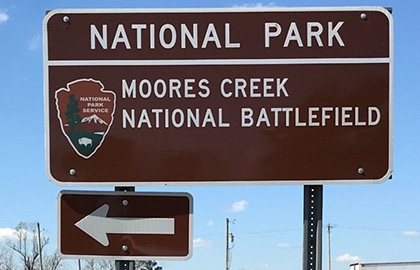
Moores Creek National Battlefield is located 20 miles NW of Wilmington, North Carolina.
½ Mile SW of Currie, NC No Entrance Fee
Click Here – Moores Creek Battlefield

Benjamin Franklin had visited Williamsburg, Virginia on Postmaster business in 1756. In 1775, he visited again. But this trip was not offered in any travel brochure! It was a secret mission … until he disappeared and found himself in a radically different Williamsburg!
Not only was this Williamsburg, Virginia in the 21st century, it was also a parallel, alternate universe. Cell phones, televisions and motorized transportation were everywhere he looked. And, there was another issue that would hasten him to find a way to return to 1775!
The unquestioning loyalty of everyone else who believed …
The British Won The American Revolution!