PHILADELPHIA
June, 1776
As the 4th of July approached, it was difficult to imagine that 56 men sequestered in the Pennsylvania State House could keep their mission a secret day after day.
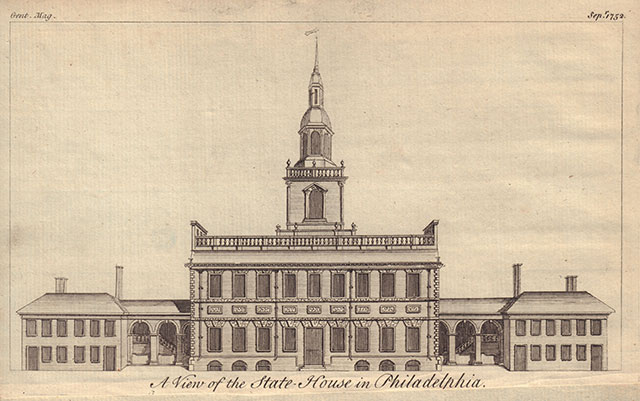
There are a few things to remember that we never think about as the 4th of July approaches:
- In 1776 the Pennsylvania State House was called just that. The name, Independence Hall would be referenced by a few earlier in 1775 as the Second Continental Congress began in May of that year. But that name didn’t really take hold until the nineteenth century, referencing both the signing of the Declaration of Independence and the Constitution.
So, historically, it is the Pennsylvania State House. Metaphorically, it is known as Independence Hall.
- In June of 1776 the population of Philadelphia was 30,000, the largest city in the colonies. That’s a lot of “nosy neighbors” who knew everyone else’s business. They would see the same 56 men (more or less) file in and out of the State House building on a daily basis. Names like, John Adams, Thomas Jefferson, and that likeable, but opinionated, old guy by the name of Benjamin Franklin.
Even George, “I’m the tallest guy in the room AND wearing a military uniform,” Washington would make an appearance on several occasions.
It appears that not all 56 delegates were present every day because of other personal/professional commitments. And on the day they met to only say, “let’s do this,” July 4, 1776, not everyone was in the room.
- These guys frequented local establishments like City Tavern, making gallons of ale and numerous alcoholic beverages disappear. Their drinking was enough to explode a breathalyzer to 8000% above the legal limit! Fortunately, there was no legal limit in 1776 Philadelphia.
So, why didn’t everyone in town know what was going on in the future, “Independence Hall?” Some of these guys were what we would consider legally drunk every day. Someone must have spilled the tea about what was going on in that windows-closed for security building during a hot June and July.
Why didn’t someone, a future Tory, run to the British and let them know that an insurrection was taking place right under their noses?
- One guy and four of his new, closest friends were holed up on the second floor of Jacob Graff’s house, just a few blocks down that street. One of them, Thomas Jefferson, was busy writing, with a quill pen, the draft of a document that he was calling the Declaration of Independence.
People walking by daily had no idea that some guy and his friends on the second floor were formalizing a document to break away from England. Their lives were about to change in ways they could never have imagined.

So, how did they keep a secret for so many weeks? It was probably more about luck than anything. When the first broadside hit the side of a building, or someone read the Declaration of Independence out loud to the public for the first time, miraculously few people knew what was about to happen. Those sneaky guys had kept a secret!
No one burned down the statehouse in a rage!
The British Army didn’t show up and arrest everyone in the building as traitors!
The people, at least a majority of them, cheered as they listened to Jefferson’s (and his friends’) words flow off the parchment for the first time!
The British Army didn’t show up and arrest everyone who was cheering!
That the British Army didn’t show up in downtown Philadelphia is a mystery to this day.
QUESTION –
Where were the British spies? Didn’t they know what was going on at the Pennsylvania State House?
QUESTION –
Where were the Tory sympathizers? Loose lips sink ships and all of those clichés.
QUESTION –
Were the British totally clueless about what was going on?
As we celebrate the 4th of July, which actually wasn’t formalized with most of the 2nd Continental Congress delegates, signatures until early August, we have to contemplate the “magic trick”, the “illusion” that was pulled off in Philadelphia that summer of 1776.
Houdini only had to keep that Elephant hidden behind a curtain for a few seconds. The founding fathers had to keep their Elephant, the Declaration of Independence, hidden behind a curtain for weeks!
As I write this article on a computer, in an air-conditioned office, two hundred-fifty years ago, Thomas Jefferson and his committee of five: Benjamin Franklin, John Adams, Robert Livingston and Roger Sherman were sweating in the Philadelphia heat using quill pens on parchment paper.
I will concede that what they were putting together was much more important than what I am saying today. But it’s the perspective of 2026 vs. 1776. A look back at HISTORY from their perspective.
An 18th-century “magical illusion” that would make Harry Houdini and even the Wizard of Oz proud!
Who Needs Parchment!
When Benjamin Franklin sat down in front of a computer for the first time, he was amazed! Tap on that plastic key with the letter on it and it magically appeared behind the glass in front of him! Who needs parchment paper and a quill?
But that’s not why he was there. With the help of the college library’s student volunteer, he was on a mission. He needed to find anything, and everything he could about a Professor Archer Murray.
What he found was priceless information about the relative of a man who once governed the colony of Virginia. A man who was NOT driven out of Virginia by patriots, revolutionaries in the pursuit of forming an independent country. He had no reason to escape with his life and become the LAST British governor of Virginia.
In 1775, the British had won the American Revolution!