London 1776
It’s a question 18th-century historians still ask to this day.
What was the British government thinking? Was the American Revolution a done deal from the beginning?
Could the King of England have stopped Parliament’s shenanigans?
Was the King behind a plot to kill the founding fathers?
(That last question is pure speculation, but certainly fodder for a book series (Saving Liberty))

It’s interesting how a question I was pondering several months ago as I was preparing my 2026 blog calendar for April just happened to be a PBS special in that same month. British writer, historian, and television presenter for the BBC, Lucy Worsley dove into the exact question that is the title of this blog.
What she discovered was what most of us have been thinking for over 200 years. It is a 100% possibility that the American Revolution could have been averted had some people in London listened to what the American colonists really wanted.
Not too long before the penning of the Declaration of Independence in 1776, most colonists had no grievance with the King or England; many of them were from there. They wanted something totally different from what Parliament was offering … but what did the colonists get?
Taxes!
But were they really averse to being taxed? Not necessarily. But, the way Parliament went about it didn’t sit well with the colonists.
- The colonies already had their own tax collection systems
- The colonists were paying their taxes
Most of the colonists didn’t know that the British government had a huge debt problem. The French and Indian War had left them badly in need of cash! Wars cost money—the people of England didn’t really want to be taxed for it. So, what do you do? What do you do?
You find someone else to tax!
“TA DAH!!!” The colonies … they won’t complain like these sniveling residents of England!
How about a Sugar Act!
This little gem in 1764 placed taxes on molasses and sugar imports into the colonies. Those two commodities were used to make rum—a top export used for trading. Unfortunately, this only affected New England, not all the colonies (so, it was actually a huge lack of revenue for Parliament).
And, when you mess with “BAHSTON” and New England, you have a new problem that you, (Parliament) created.
BOYCOTT!
“We don’t need no stinking tea!” Along with other British goods. That “Tea Party Thing” would become infamous in the annuals of history.
“Okay, so we messed up! We need more revenue, and those pesky Bostonians are now boycotting our “stuff”! What do we do? What do we do?”
Welcome to The Stamp Act!
It was something like a stamp we put on envelopes today … but different! It was actually the “paper” that was being taxed. Specifically, the paper used for legal documents.
It was officially named, Duties in American Colonies Act 1765. You might notice that this was over ten years before the Declaration of Independence.
You want to buy or sell a business? You want a marriage license? Any legal document. But it didn’t stop there. It was a tax on newspapers, pamphlets … all printed resources. Everything paper was now an “Official Document” that needed an official TAX STAMP!
The problem?
No one asked the individual colonies, or the colonists, if they wanted to participate in this particular “scheme” of:
TAXATION WITHOUT REPRESENTATION!
Today, you open your phone bill, electric bill, water bill – Most can agree …
- City Taxes – Okay, I live here
- County Taxes – Okay, I live here
- State Taxes – Okay, I live here
Federal Taxes – I DON’T LIVE THERE!
For the colonies, Parliament was almost 3,500 miles east, across the pond! I DON’T LIVE THERE! It was a clear-cut case of …
TAXATION WITHOUT REPRESENTATION!
AGAIN!
The Stamp Act was finally repealed and that could have, or should have been the end of that. The British government learned their lesson … right? Absolutely not!
“How dare they complain! We’re going bankrupt from that war!” Which led to …
A brilliant idea from Parliament and the King. “Let’s give the colonies a say in Parliament. Bring over some delegates from the colonies to debate such things as taxes.” Of course …
“We’re kidding!”
How about some MORE taxes!
The Townsend Acts!
1767 & 1768
These were a series of tax acts on British imports; paper, lead, glass, and how about we throw in TEA! For some reason the British government could not grasp, the Townsend Acts caused various types of protests in the colonies. That was the last “crumpet” for Parliament.
“This time we’ll send in the troops!” And they did.
This didn’t sit well with the fine people of “BAHSTON” Chests of tea vs. winter Boston Harbour water … not a brilliant combination! But in December 1773 a group of dubious characters decided to have “A Party!” No one is really sure who was the instigator, but the Sons of Liberty have been given credit.
“Calm down everyone! The British Parliament will surely come to their senses and hold off on taxes and start talking with the colonies.”
Not a chance!
But now, taxes were no longer the issue!
The Coercive Acts!
1774
Five more “British Government” acts made their way to the colonies, specifically Massachusetts. Of course, they were not consulted. In their effort to punish Massachusetts specifically for the Boston Tea Party, Parliament “missed the boat” on the bond the other colonies had with Massachusetts.
The Boston Port Act, Massachusetts Government Act, Administration of Justice Act, Quartering Act and the totally unrelated Quebec Act were passed as one bill in 1774. Massachusetts was stripped of rights and self-governance.
Leading up to September 1774, just before the formation of the First Continental Congress to discuss how to respond to Parliament, there were still colonists who hoped the British government would come to its senses and work with them for a solution.
Instead, Parliament was looking to make an example of those in Boston and stop the colonial resistance to their “reasonable” demands. Something they had kicked off in 1764 with the Sugar Act.
TAXATION WITHOUT REPRESENTATION!
So, was the American Revolution a done deal from the beginning?
Could the King of England have stopped Parliament’s shenanigans?
This escalating conflict was even more absurd when all the colonies wanted was a say in politics!
So, let’s get this straight!
Parliament & the King had a sure-fire solution that everyone (meaning only them) could agree on:
PROBLEM: Too Many Taxes, No Representation – The Colonists Are MAD!
SOLUTION: More Taxes, Still No Representation – The Colonists Are MADDER!
What were the British thinking?
You might think that ALL British people living in England were cheering on Parliament. That was absolutely not a fact. There was dissension, even outright treasonous acts, but it was AGAINST what was going on in the colonies—Parliament was wrong, the colonies were right! There were never any mass demonstrations in the streets of London by the populous demanding the colonies be “burnt to the ground” for disobeying the King!
It also appeared that the King might not have been on the wrong side of this tax thing, at least in the beginning. How much involvement he had at the start was debatable. But, as things heated up, he became quite involved and, uncharacteristically, belligerent!
And the question of most importance—was all of this tension necessary?
What were they thinking?
I agree with Lucy Worsley, who rightly made the case that there were several “stop points” along the way. Somebody’s ego was getting stepped on in the beginning. And then, many somebody’s—at the British government level.
The colonists didn’t want a revolution. They just wanted to be represented in Parliament.
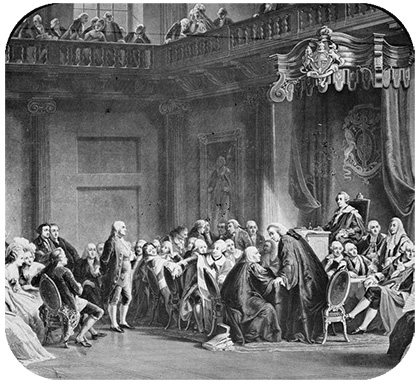
By the time Solicitor General Alexander Wedderburn verbally and brutally chastised Benjamin Franklin for over an hour in front of members of Parliament, even Franklin knew it was too late. It was only January 29, 1774, but as a diplomat, Franklin had hoped that he could salvage the relationship between Britain and the colonies. But it was too late, and he would soon return to the colonies.
Historians perceive that was the moment when Franklin took the monumental turn from diplomat, to activist! Parliament was not a rational body of men. Benjamin Franklin was quickly becoming a revolutionary, and he would soon consult his friend, Thomas Jefferson, on the most important document the colonies would ever see. A Declaration of Independence.
Franklin knew something was wrong. Something nefarious was in the wind.
This would lead him back to Virginia to warn the Founding Fathers of a plot to terminate them—permanently—before a war ever started.
May 1775, Williamsburg, Virginia—Stirling Plantation was about to get an unexpected visitor—a secret Mason gathering—and an abrupt disappearance of that unexpected visitor.
No one knew Benjamin Franklin was coming to Virginia, and when he disappeared that cloudless night near the James River, no one could ever have imagined to where … when he had vanished.