EVERYONE’S MOVING TO CANADA!
Boston: March 17th 1776
Sometimes you just know it’s time to move!
The housing prices are right. The political climate is changing, and your neighbors are jerks!
The first one probably didn’t affect the British in Boston, but the second two certainly did.
In March 1776, the Rebels, the Revolutionaries, the … whatever name the British wanted to give them were surrounding the city.
The people who never asked the British to take over Boston were currently controlling Dorchester Heights above the city. Colonists (Patriots) built fortifications at a furious rate, surprising even the British. Boston Harbour was now vulnerable, with the British navy somewhat sitting ducks. There were also privately owned civilian ships in port that had to be taken into consideration.
When the Commander of the British Navy in Boston tells you, “We’ve got a problem!” You probably should listen. “If they stay up there … we’re going to be at the bottom of the harbour!” is a pretty solid motivator for any General.
There were two basic options for British General William Howe. First, he could take his professionally trained army up the hill and take over just like he had done a year earlier with Breed’s Hill (Bunker Hill), or, they could leave! Pack it up! Load up the trailer and get out of Dodge!
Yeah! That last one wasn’t really an option!
Until it was!
Just like it’s not supposed to be 105° in Phoenix, in March … extremely bad weather in the area made the second option the ultimate choice, at least that’s what Howe might have wanted everyone to think. No one knows.
Unknown number of casualties vs. Don’t Let The Door Hit You In The … was probably what he was really thinking.
And if you’re thinking that shouldn’t be so hard … just pack up and leave. Not so fast! An estimated 170 ships in the harbour area (as per a count by Abigail Adams, John’s wife), close to 9000 British troops, and 1500+ loyalists and children were in the city. All needed a ride out of town and up to the British naval base in Halifax, Nova Scotia. Generally, it was a 3-4 day voyage depending upon many different conditions, not the least weather and wind.
This moving thing should work out great! Maybe we can get your brother-in-law to help us!
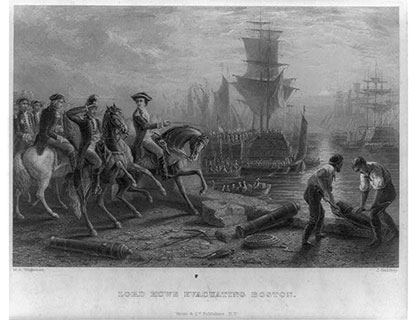
To say this was one of the most disorderly evacuations ever seen would not be how the British higher-ups would try to spin it, but it was. Even George Washington was appalled at the lack of planning and organization.
Confusion reigned supreme in the city. Would the British burn it down? Would Washington take advantage of the situation and bomb the city from Dorchester Heights? (In retrospect, that might not have been such a bad idea—at least clog up the harbour with debris). Instead, the British got a free pass to leave. Their fleet did get harassed, but not by the Army on the hill. Privateer vessels manned by Americans caused some havoc, but not enough to stop the flow of ships out of the harbour.
Weight, and enough room for soldiers and civilians (Tories) was an issue for the British navy and not everything could be removed from the city. Heavy cannons found their way to the bottom of the harbour. And if you were looking for a new horse … come on down … they’re free!
That didn’t mean there wasn’t some looting of shops and homes—“justifiable” if the Americans could use them as supplies. And the Tories/Loyalists who decided to hitch a ride were not shy about destroying property or possessions. Unfortunately, the last laugh was on them, as the rich and famous were treated the same as the lower echelon when they boarded the ships. These ships were built for moving soldiers, not luxury cruising.
Welcome to your bed on the floor of Lido Deck!
Of course, the Governor and Lt. Governor of the great state of Massachusetts also boarded the ships. Governor Hutchinson and Lt. Governor Oliver decided that being partners in the birth of a new country was not part of their legacy.
The British Navy Moves to Halifax, Nova Scotia
By March 17, the majority of the British forces had left Boston harbour for the three … four-day trip north to Nova Scotia. A few British ships stayed on the outer fringes of the harbour as a safety measure—the old military and football strategy—cover your flank.
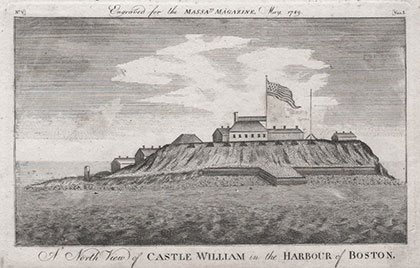
In one last gesture of disdain, the British destroyed as much as they could of Castle William, a fortification protecting the entrance to the harbour. It was quickly rebuilt that same year and renamed. The new Fort Adams was again renamed in 1799 as Fort Independence, the current 30-foot granite wall now fortress/museum.
 Benjamin Franklin wasn’t moving to Canada, but he sure was moving. There was something about his new view of Williamsburg, Virginia that just didn’t seem right! Maybe it was the strange pavement on the street. Maybe it was most of the people with their British accents. Maybe it was those little devices in their hands that they kept talking into. Maybe it was that … BUS! speeding down the street near him!
Something was definitely wrong. Moments ago, he was in Williamsburg, but it was 10 miles from where he was standing. And, it was 1775!
Not only was he now in the 21st century, but he was also in an alternate universe. But this was not the universe he was hoping for. Had it really happened?
The British Won The American Revolution!